Desire Of My Soul

Combat Zone Series: Part 3—Rules of Engagement


Connected upward, yet pulled down ward

That is the battle within your soul.

But it’s for a purpose. And it’s good.


© desireofmysoul.faith & SoulBreaths.com. All rights reserved.


[Combat Zone series is the foundational post for soul basics.


SUGGEST READING PARTS 1 & 2 FIRST: COMBAT ZONE: PART 1—YOUR SOUL and COMBAT ZONE: PART 2—SOUL NUANCES


READING TIME: 3 MINUTES plus end scripture list.


Symbiotic. That’s what some rabbis say about the soul-body dynamic. You are a God-breathed soul—its biblical references breath, spirit/wind that rises/descends, and a “rested” life force—clothed in a body that’s from the earth and tethered to this world.


Your soul is called upward, the body downward. And so the battle ensues, along with a host of other factors that complicate your soul story (mentioned in Combat Zone, Part 1).


Here are five rules of engagement to help you stay the course and finish the race . . . well.


RULES OF ENGAGEMENT #1:

SECURE YOUR POSITION


We’re teetering on a broken bridge. Since the Garden of Eden debacle where rebellion exposed our desire for self vs. God, the dividing line was clear. God alone is holy. There are none righteous among us per His Word, often shared in this series and throughout this blog:


Genesis 8:21b, Ecclesiastes 7:20, Isaiah 59:1-2, Isaiah 64:6, Psalm 14: 2-3, Psalm 53: 3-4, 1 Kings 8:46, Jeremiah 17:9-10, Romans 3:23, Romans 3:10, Romans 8:6, among others.


But God is love, merciful, and l-o-n-g-suffering. So He made a way to restore that relationship with Him. There were temporary measures at first—blood sacrifices that had to be repeated daily, annually.


But those were mere shadows of what was coming, the greatest gift . . . a one-time holy sacrifice. A doorway giving us access to the Father, ADONAI, our Lord, our Master.


Fulfilling the soul’s journey begins with receiving the restoration gift from God: Jesus (Yeshua, in the Hebrew), our promised Messiah, the Son of God.


From there, your soul grows and is transformed by letting your soul [neshama], its wind/spirit [ruach] rest [nafash/nefesh] within the fibers of His presence, His Word, His ways . . . being hidden in Him, where you’re surrendered. Total white-flag territory.


It’s where your soul-body gets into sync,
working as a whole with God, bowing before Him.


God’s way of restoring relationship with Him:

“I am the Truth, the Life, the Way . . . no man comes to the Father except through me.”

—John 14:6. The Messiah, Jesus (Yeshua, his Hebrew name)


RULES OF ENGAGEMENT #2:

HONOR YOUR KING, YOUR COMMANDER IN CHIEF


It’s our human default to lean on our own understanding and to even get caught up in the emotions and mindset of the world at large.


But a good soldier needs to stand under his commander.


This slight paraphrase of Isaiah 8: 12-14 helps draw some clear-thinking guidelines. I’ve fleshed out the meanings of “fear” and “awed” from the Hebrew for a better visual.


Don’t fear (be shaken, swept into conspiracies) what people fear
(what they call conspiracies) nor give strength to it
or be awed (shaken terribly, oppressed) by what awes them.
Let God be the object of your awe (trembling holy fear) . . .
consecrate Him.
He alone is to be your sanctuary.


FAITH vs TRUST

AH, THAT’S THE THING.


ֱHebraically, faith—emunah (eh-moo-nah, אמוּנָה—means a knowing or understanding of who God is. He’s great, awesome, creator, redeemer, father, lover of our soul, and has His hand in the details of the world.


ֱTrust—bitachon (bee-tah-khon, בטחון) with the root batach—means trust, leaning on, resting on. So you might know that God is who He says He is . . . but bitachon means you put that emunah (faith) into action.


God is the author and perfecter of our faith—and the holy fire fueling that faith into motion.


Case in point: The Lord gave me a vision (more than once) when I was at a difficult part of my life. There I was in the vision, standing on the precipice of a huge, wide chasm—with God calling me to the other side. My soul knew what He wanted . . . my faith to move in action, to step out, to trust that He would break forth the impossible. To trust that He’d let the unseen be seen, manifesting what was totally illogical to my human mind.


Honestly, I rather think He joys over those moments when we really have only one choice—Him. A Father who delights in revealing more of His character as He watchfully coaxes His children to learn more and walk higher.


And so, in the vision, trust moved one foot off the ledge and stepped onto nothingness. But in that exact nanosecond, part of a bridge appeared beneath my foot. With each trust-step forward, God allowed another piece of the bridge floor to meet my foot until I reached the other side. To a place deeper in Him.


It’s like God is saying to you and me in our 21st century lives: Get out of the boat. Not to waltz on the shore but to activate our bitachon/trust and walk on the water with Him.


When that happens, we can consecrate God as Isaiah 8:14 commands.
 

Setting Him apart from all else for our hearts’ sake.

Setting Him apart from all else for our souls’ desire and strength.

Setting Him apart from all else for our daily lives and circumstances.

Setting Him apart from all else and recognizing Him as our sanctuary.


Bottom line for this Rule of Engagement: Know (emunah) that He is your sanctuary—but bitachon, actively live and move as if He is your sanctuary. Your refuge. Your protection. Your provision. Your home. Your very breath. Because He is.


You are soul journeying to more than a place. You are heading to ha makom (ha-mah-kome), the place—only to discover that the place is God Himself. He is ha makom, the destination, the journey, the place of holiness.


Remember, for the spiritual battle, your nefesh—the Hebrew word for soul referring to the life force that can cling, negatively or positively—needs to obey orders.


Clinging to God means He’s in front and you’re behind Him. That’s how you stay in position. That’s how you follow and honor your Commander-in-Chief.


Psalm 63:2, 9 (1, 8). O God, You are my God, I seek You. My soul [nefesh] thirsts for You, in an arid and thirsty land, without water. My soul [nefesh] clings to your hind parts; Your righteous right hand upholds me.


RULES OF ENGAGEMENT #3:

KEEP YOUR EYES RIGHTLY FOCUSED


You are battling on two main fronts—the spiritual world (your soul against the principalities and powers of the enemy) and the physical world. Like in any war, things shift, take on different patterns.


Do you know what you’re really seeing—or is it a delusion, a camouflage? There’s only one way to hold your position while waiting for intel about what’s really going on in a realm you can’t physically see or physically touch. Stay mindful, focused, in God’s presence.


“So we fix our eyes not on what is seen, but on what is unseen, since what is seen is temporary, but what is unseen is eternal.” 2 Corinthians 4:18


What is unseen . . . is God. Yet you are called to fix your soul’s eyes on Him, the Eternal One, to see more clearly in the battles down here. To not lose heart.


Although the body (“outer man”) is decaying and warring, your inner essence, your soul—breath from God/neshama, spirit/ruach, inner living substance/nefesh—is being renewed day by day in Him.


The next two scriptures reveal what your stance should be in battle . . . do what He has ordered to the best of your ability, then STAND.


Don’t leave your post. Stand, confidently, expectantly, faithfully in Him. Even (and especially) when the order is to simply wait.


“Be strong and courageous! Do not tremble or be dismayed, for the LORD your God is with you wherever you go.”—Joshua 1:9.


“Finally, be strong in the Lord and in the strength of His might. Put on the full armor of God, so that you will be able to stand firm against the schemes of the devil. For our struggle is not against flesh and blood, but against the rulers, against the powers, against the world forces of this darkness, against the spiritual forces of wickedness in the heavenly places.
—Ephesians 6:10-14a


READ THE LAST TWO RULES OF ENGAGEMENT NOW:

COMBAT ZONE: PART 3b—RULES OF ENGAGEMENT


PHOTO CREDIT

Sniper girl photo by Piotr Will on Unsplash.com


Combat Zone is the foundational post for soul basics. The original article was created/posted in 2009, but for easier reading divided into three posts in 2020. Judaic scripture number references used with Christian numbering in parentheses when it’s different.

Combat Zone Series: Part 3b—Rules of Engagement


Encouragement for your soul. The last two Rules of engagement to strengthen you for life’s battles.


© desireofmysoul.faith & SoulBreaths.com. All rights reserved.


SUGGEST READING PARTS 1 & 2 FIRST BEFORE PARTS 3 and 3b: COMBAT ZONE: PART 1—YOUR SOUL and COMBAT ZONE: PART 2—SOUL NUANCES


READING TIME: 3 MINUTES plus end scripture list.


Yes, the battle rages around (and in) us. But God is a mighty, mighty warrior—LORD of the battle. His ways always win. So breathe in His rest, comfort, stillness. His power, majesty, and loving faithfulness will never fail you.


And keep these last two Rules of Engagement in mind.


RULES OF ENGAGEMENT #4:

KNOW YOUR WEAPON


Photo by Piotr Wilk on Unsplash

Be prepared—in season and out of season.


Go through basic training and refresher trainings with your weapon (the Word of God), just like a soldier needs to qualify for live-fire drills—and the real thing. Because this daily battle you and I are in is always the real deal.


SO STAY IN HIS WORD. It is life, it is renewing, it is Truth that will show you where to walk and help you not be derailed in your soul journey down here.


Check out this insightful passage from the New Testament (the Soul Nuances are inserted to help connect the dots for you) . . .


Hebrews 4:12. See, the Word of God is alive! It is at work and is sharper than any double-edged sword — it cuts right through to where soul meets spirit [dividing where those Hebrew soul/spirit words intersect—neshama, ruach/spirit, nefesh ] and where joints meet marrow [dividing where your vessel/body’s inner parts intersect], and it is quick to judge the inner reflections and attitudes of the heart.


PRAYER! Full-on, distractions blocked. Prayer is warfare in the spiritual realm. It’s where the war is won, really. With that, I’d strongly add worship since worship is battle—and it is prayer. The two work together, interlocked for intense spiritual fighting, using both simultaneously.


James 5:16 nails it simply: The prayer of a righteous person is powerful and effective.


So crank up powerful worship music, grab your Bible, humble yourself before the Lord, and get to it!


Sing-pray His Word through the attacks, valleys, and even on those mountaintops to keep a lookout and get prepared in season and out of season.


[Recommendation: My go-to music is from previous worship musician/singer/songwriter Rick Pino—from his warfare albums to his stirring songs before the Lord. I had the privilege of meeting him briefly after one of his musical events in Santa Rosa, CA when I lived in the Bay. God had used Rick’s music to get me through a deeply difficult time.]


RULES OF ENGAGEMENT #5:

KEEP COMMUNICATION LINES OPEN—AND STAY ALERT


This is soul-to-soul communication, yours and God’s. Report what’s going on, what you see, what you’ve done, what you need—and wait for God to respond and lead. Sometimes you aren’t to speak—just still your soul and listen.


Psalm 42:7, a downtrodden soul [nefesh per the line prior] calls out to God: Deep [tehom, תְּהוֹם, subterranean waters of the soul] is calling to deep at the thunder of Your waterfalls; all Your surging rapids and waves are sweeping over me.


There, in the deep part of your soul, humbled and hungry to reach His soul’s deep, is where holy communication is sparked, where you discover yet another layer of who He is, what He is, where He’s moving, how He’s guiding you, what He’s saying to you for this season of your life.


HIS WATERFALL OF REFRESHMENT FLOWS FROM HIS THRONE, RELEASING . . .


revelations

prophetic actions

words of knowledge

wisdom

discernment & understanding

provisions

His never-ending

L

O

V

E

mercy & grace

long-suffering

forgiveness


THAT’S HOW YOU CAN STAY SPIRITUALLY IN SYNC WITH HIM.

BECAUSE REMEMBER: THE ENEMY IS ON THE PROWL.


Always, as it so happens. So be ready for hostile fire. He roams the world to see who he can devour, derail, destroy.


Watch out for the big sweep: So-called spirituality—as the term is used in the world today—that brashly proclaims there are “many ways to God.” It’s another tool of the enemy. False roads leading to death, not God’s eternal life.


You won’t find God’s truth in . . .


~ rote mantras

~ transcendental meditation</p>

~ crystals

~ astrology & tarot cards

~ trance-like states, psychics, palm readers

~ or all the rest of the “New” Age and one-world religious systems


Same goes for fashioning your version of God . . . that’s called idolatry.


Securing your position in Him is about connecting with Him on His terms and His Word, not the world’s, not yours, not mine.


God has made His terms clear from Genesis onward, revealing His holy character, His holy desires, His holy ways.


READ THIS FINAL COMBAT ZONE POST WITH A FILM NOIR BENT. COMBAT ZONE: PART 4—SOUL VIA A FILM NOIR LENS


SCRIPTURES: BE ENCOURAGED


Exodus 34:6 Then the LORD passed by in front of him and proclaimed, “The LORD, the LORD God, compassionate and gracious, slow to anger, and abounding in lovingkindness and truth.


Lamentations 3:22-23 The LORD’S lovingkindnesses indeed never cease, For His compassions never fail. They are new every morning; Great is Your faithfulness.


Deuteronomy 31:6 Be strong and courageous. Do not be afraid or terrified because of them, for the LORD your God goes with you; he will never leave you nor forsake you.


Deuteronomy 6:5 & Matthew 22:37. You are to love Adonai your God with all your heart and with all your soul and with all your strength.


Psalm 55:16-18, 22 . But I call to God, and the Lord will save me.
Evening and morning and at noon, I utter my complaint and moan, and he hears my voice.
He redeems my soul in safety from the battle that I wage, for many are arrayed against me.
Cast your burden on the Lord,and he will sustain you; he will never permit the righteous to be moved.


Matthew 11:29. [And Jesus/Yeshua said] Come to me, all of you who are struggling and burdened, and I will give you rest. Take my yoke upon you and learn from me, because I am gentle and humble in heart, and you will find rest for your souls.


John 4:23-24. But the hour is coming—indeed, it’s here now—when the true worshippers will worship the Father in spirit and in truth; for the Father is seeking such to worship Him. God is spirit and those who worship Him must worship Him in spirit and in truth.


PHOTO CREDIT

Sniper girl photo by Piotr Will on Unsplash.com


[Combat Zone is the foundational post for soul basics. The original article was created/posted in 2009, but later divided into shorter posts for easier reading.

Combat Zone: Three Scripture Examples


Connected upward, yet pulled downward.

That is the battle within your soul.

But it’s for a purpose. And it’s good.


© SoulBreaths.com. All rights reserved.


READING TIME: 1 MINUTE.


Take a sec to read three quick examples of how the translated word “soul” is synonymously used for those three Hebrew words used in the COMBAT ZONE SERIES: PART 2—SOUL NUANCES (neshama/nishmat, ruach, nefesh) and even their equivalent in the New Testament Greek.


1. Job said, “As God lives, who has taken away my right,
and the Almighty has established my soul (nefesh, my life force, rested breath).
For as long as my soul (nishmat, breath of life attached to God) is within me
and the spirit (ruach, breath, wind) of God is in my nostrils,
my lips will speak no injustice and my tongue will utter no deceit.
Job 27:2-4


2. The spirit (ruach, breath, wind) of God made me, and the breath (nishmat, breath of life, attached to God) of the Almighty keeps me alive.—Job 33:4


3. There also are poetic uses of these synonyms, like the metaphor in the New Testament’s letter to the Hebrews (4:12) that vividly underscores the laser-like intensity of God’s Word (active, alive, sharper than any two-edge sword) to expose our thoughts and intentions . . .


It can divide the “soul”—(Greek is psyches like nefesh for self, human person, the consequence of God’s blowing life into a person)—from the “spirit” (Greek is pneumatos, like ruach for breath, wind, spirit).


Meaning: The razor-sharp sword of God’s Word slices through (divides) the intricately connected nuances of the soul much like it can slice through our physical joints from its innermost part, the heart-of-the-matter marrow.


Combat Zone Series: Part 4—Soul Via A Film Noir Lens


Connected upward, yet pulled downward.

That is the battle within your soul.

But it’s for a purpose. And it’s good.


© desireofmysoul.faith & SoulBreaths.com. All rights reserved.


GET THE SOUL BASICS FIRST. READ PARTS 1-3. START HERE: COMBAT ZONE: PART 1—YOUR SOUL


READING TIME: 4 MINUTES


Life has its ragged edges. The God-breathed soul in its earth-tethered body has a job to do. But things can get messed up, turned upside down, or totally d-e-r-a-i-l-e-d.


Italian filmmaker Federico Fellini may not have been thinking about the soul-body dynamic when he made Nights of Cabiria (Le Notti di Cabiria), but there is a parallel nonetheless.


CHARACTER’S SOUL


Fellini’s 1958 film is hauntingly compelling, a gritty window into the human condition. Protagonist Cabiria, a tragic-comedic, quirky personality wiggles into your heart, in the raw places. The uncomfortably-yet-so-real places we know but too often pushed down.


She is a . . .

darkened

lonely

wandering

soul

who wants to break loose of herself.


A lady of the night, but her true self— her soul’s identity—longs to be freed. Her plight could just as easily be yours, mine, or anyone else’s on the planet. After all, there are trenches and stench holes even in the finest high places and people.


Her life is a series of abuse, being used, deceived, unloved, lost, and nearly killed (twice) for her money.


From the beginning when her boyfriend pushes her into a lake and steals her purse to being set up and ridiculed at a magic show and on to the cruelest betrayal of a would-be fiancé, Cabiria streetwalks for her profession while her soul walks the inner streets of its journey, with slowly unfolding realizations.


Compared to her cohorts, there’s something distinctly different about Cabiria. They’re contently oblivious to their boxed-in existence. Not her. She’s clothed in an unexpected resilience. Dares to hope. Dares to find ways to be free from the civil war within and around her.


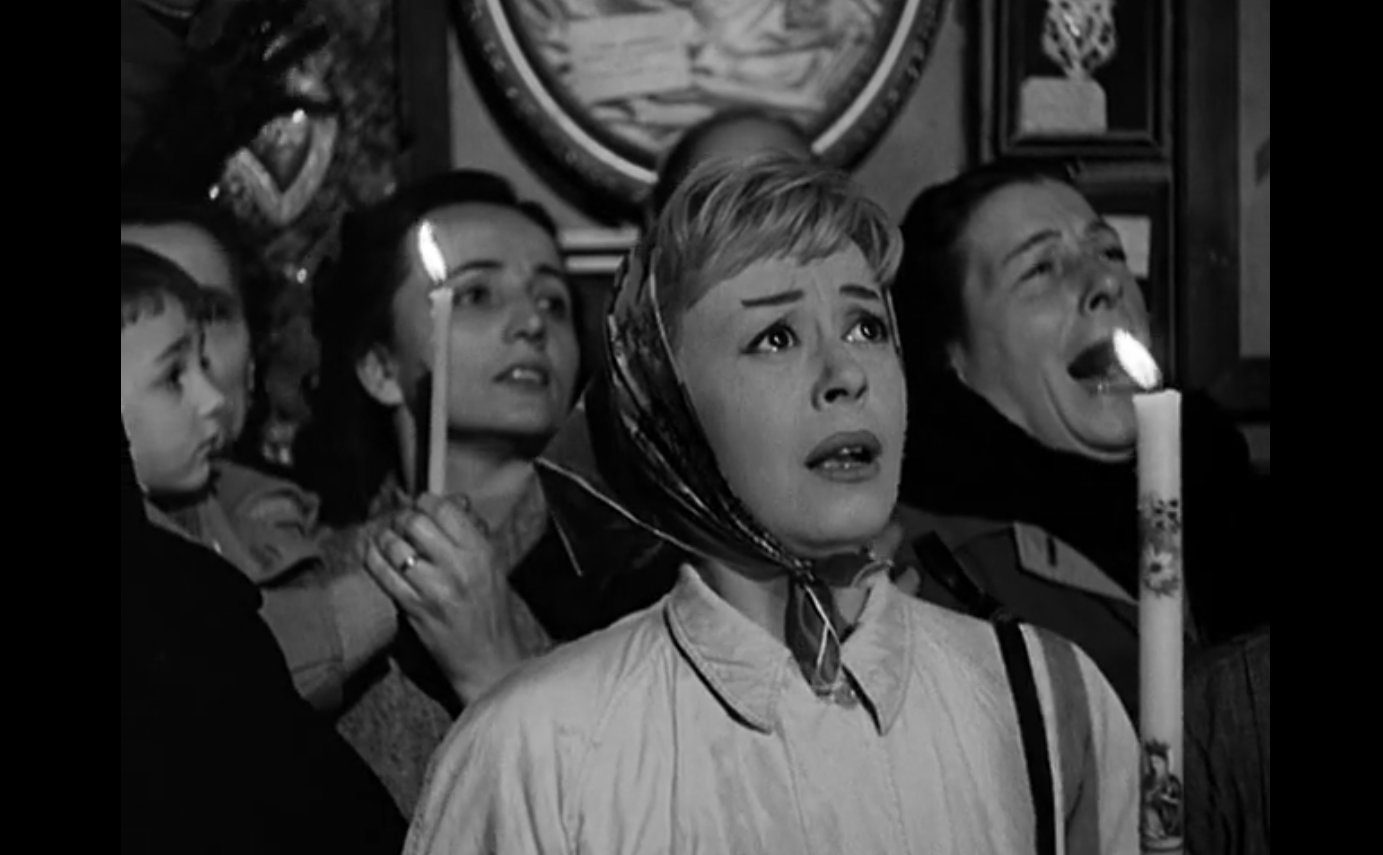
Swept along the Roman religious processional—priests, candle-carrying altar boys in garb, followed by suit-clad men and penitent, scarf- covered women drudging behind on their knees—Cabiria seeks religion as a cure and cries out for a miracle in her default, Roman Catholic style.


She stands, her face painful, nearly angelic, amid the lonely, the crippled, the children, the women and men, the poor, the forgotten.


Cabiria reaches up to find her soul's release.

Cabiria looks to a familiar source, her default religion, hoping to find her soul’s release. [pic from Federico Fellini’s Le Notti di Cabiria]


But the next day, she’s sitting with a few others on the processional grounds. Scattered debris surrounds her, the aftermath of the previous evening’s religious fervor.


A musician strums his guitar.

Teens plays ball.

Her friends eat, drink, dance.

The reality crashes in on her.


We haven’t changed.

Nobody’s changed.

We’re all the same as before, just like the cripple.

Nights of Cabiria, Fellini film


Mise-en-Scène. Let’s look at the real elements in her story. Which, in the big-picture view, are not all that different from yours or mine on any given day.


She is breathed by God, yet her soul/spirit clings to the ways of her world-tethered body and follows it down spiritually deserted corridors—instead of clinging to Him. Over time, spiritual darkness consumes her soul, causing a spiritual chasm. Her soul can’t breathe or flow as it was designed to do.


Despite her religious attempts, a real transformation, that coming-full-on-to-God moment in her soul, isn’t happening. She’s still looking for something spiritual amidst something physical.


So when the cripple isn’t healed and her friends return to their worldly ways . . . hope is MIA, nowhere to be found. And her soul is right where it was before, unable to breathe in and breathe out the truth of God.


CABIRIA’S SOUL MOMENT


The invisible iron bars of Cabiria’s physical slave market pierce through her soul-body. She dreams of freedom, but is incarcerated emotionally and spiritually wherever she goes.


Her cries upward are genuine. But the earthbound religious exercises leave her chained, her soul in bondage.


There is only One who can deliver her, from the inside out. Will He step in, remove the veil, awaken her soul, letting her see His beauty, sparking a deep-calling-to-deep type of miracle?


We can all pretend to be cynical and scheming . . .
but when we’re faced with purity and innocence,
the cynical mask drops off and all that is best in us awakens.
—Nights of Cabiria, Fellini film


Toward the end of the film, Cabiria is manipulated and discarded yet again, left with mutilated expectations.


Her soul hits ground zero. Physically, she collapses on an elevated drop-off, deep waters below. All a deft portrait of her soul-life journey.


But then . . . a stirring. Emptied, teary-eyed, she pulls herself up and starts to walk through the wooded area.


Children and young people come out and walk with her, singing, playing music, happy, filled with life.


And hope. A different level of hope seen through a new soul lens.


A mascara-stained tear rests under one eye—and slowly her visage morphs. She looks around her and sees new life bursting from the young people and music. It’s then that she turns to gaze into the camera for a few seconds.


She’s showing us something—something deeper rising from her soul.

Saddened eyes filled with a thousand stories.


The soul's awakening.

Cabiria . . . her soul awakening. [pic from Federico Fellini’s Le Notti di Cabiria]


Battle-scarred emotions . . . her spirit/feelings/inner thoughts (ruach in Hebrew) daring to stand.


A humbled soul . . . her previously self-driven life force (nefesh in Hebrew) finally beginning to remove itself from the worldly wanderings and tasting the “rest” within.


Then a frail smile breaks through . . . her breath of God, attached to Him (neshama in Hebrew) kindles her inner soul lamp.


And maybe . . . hope. The kind that can only come from the One who is truth, who gives abundant life the way He designed.


Go further with your soul story. Read the Combat Zone’s soul basics series for ways to maneuver your soul battle. Start here:

COMBAT ZONE SERIES: PART 1—YOUR SOUL

Resurrection, Real or Not: Part 1—What God Revealed

It’s real . . . with sneak peeks throughout the Bible to prove it.


© desireofmysoul.faith & SoulBreaths.com. All rights reserved.


READING TIME: 5 MINUTES.


Death. Is it a body decomposing into nothingness, trapped in a waiting-for-Godot moment—as Emily Dickinson portrays, rather derisively, in her “Alabaster Chambers” poem below? Or is it a future transition of the soul-body union into something far greater?


Safe in their Alabaster Chambers—

Untouched by Morning

And untouched by Noon—

Lie the meek members of the Resurrection—

Rafter of Satin—and Roof of Stone!
—Emily Dickinson, original first stanza;
later published in her third. version posthumously, in 1890


You probably have your take on the resurrection matter. But opinions and poets aside . . . the real question is, what does God say? In His words, the Bible. After all, it’s His creation, His rules, His story. The gist of His resurrection event unfolds like this . . .


Death isn’t the end. It’s another beginning. The soul is eternal.

God said to Moses, “I am the God of your father, the God of Abraham, the God of Isaac, and the God of Jacob.” At this, Moses hid his face because he was afraid to look at God. —Exodus 3:6, approximately 1446 BCE.


What was God saying?
I am the God of your father—not I was.
Your father’s soul is with Me. His soul is not dead.
Abraham, Isaac, and Jacob have long past from this world,
and yet, their souls are alive.

I am their God.


But God doesn’t leave things suspended there, with the eternal soul separated from its earthly vessel (the body) . . . the design from the beginning was for us to enjoy an everlasting soul-body existence made holy unto Him.


That’s why an integral part of the what’s-ahead story is the soul-body reunion, coming at the end of (future of) days—called acharit ha-yamim in Hebrew, אחרית הימים—orchestrated by the hand of God.


He’s been telling humanity about that for thousands of years—and He’s given ten sneak-peek accounts of it to make this seemingly preposterous resurrection notion understandable to us, recognizing it as a valid upcoming event.


The links for the resurrection accounts are in the last part of this post, including a link to a brief timeline of some resurrection clues, starting with 1400s BCE/BC.


ALL THAT BEGS THE QUESTION


Since resurrection is a futuristic event, what is our life down here about?


There’s much to that answer—some discussed in this series and elsewhere on this blog. But for now, as one rabbinic source puts it . . .


This world is like a lobby before the World to Come;
prepare yourself in the lobby
so that you may enter the banquet hall.
—Rabbi Yaakov, Pirkei Avot 4:21

(Ethics of our Fathers, ethical/moral Torah teachings
from the Mishnaic 2nd century CE period)


Keep this in mind: There are no do-overs. No reincarnation to try it again. God’s Word is pretty straightforward about that. That’s why what you do down here in the “lobby” is critical.


It all comes down to this: God is sovereign. He sits on the throne as judge—both justice and mercy.


But for the mercy part, you need to be living according to His divine plan for your soul, His roadmap—not doing your own thing or believing your version of what He said.


marija-zaric-wMybzaBOaSQ-unsplash


RESURRECTION: SNEAK PEEKS


Explore each account via the links below. These resurrected people went on to live again . . . but eventually had to die again and now await the resurrection occurring at the end of days.


That is, all except one.

The Life Giver . . . and Life Changer.

The Restorer, Repairer, Healer.

The Redeemer. The Messiah.


There’s more coming up about that singularly unique resurrection story in this series. But now . . . those real-life resurrection accounts.


Real-Life Accounts

Real-Life Accounts Cont’d

The Resurrection Thunderbolt From Heaven

Rabbi Scholars Defend Jesus’s Resurrection

Why A Bodily Resurrection

His Righteousness Can Be Yours

Biblical timeline of resurrection cues and sneak-peek accounts


RELATED RESOURCES

McFarland, Philip (2004), Hawthorne in Concord, New York: Grove Press, p.149, ISBN0-8021-1776-7.


Royot, Daniel (2002), “Poe’s humor”, in Hayes, Kevin J, The Cambridge Companion to Edgar Allan Poe, Cambridge University Press, pp. 61–2, ISBN0-521-79727-6.


http://www.jewishencyclopedia.com/articles/13614-shulamite


http://jwa.org/encyclopedia/article/shunammite-midrash-and-aggadah


https://www.biblegateway.com/resources/all-women-bible/Great-Woman-Shunem


http://www.chabad.org/library/article_cdo/aid/107781/jewish/Ani-Maamin-I-Believe.htm


http://www.myjewishlearning.com/article/jewish-resurrection-of-the-dead/


Book of Acts timeline. https://biblehub.com/timeline/acts/1.htm/


Photo Credits

Resurrection/Tomb photo by jchizhe, purchased on iStock.com (Stock photo ID:1243063771)

Bible photo by Kelly Sikkema on Unsplash.com

Gavel photo by Tingey Injury Law Firm on Unsplash.com

Roll the Drums photo by Marija Zaric on Unsplash.com


Resurrection series initially created between March 30, 2016 – July 3, 2016, then later divided into various posts for easier reading

Resurrection, Real or Not: Part 2a—Real-Life Accounts

Three resurrection accounts set the spiritual ball in motion.


© desireofmysoul.faith & SoulBreaths.com. All rights reserved.


READING TIME: 4 MINUTES.


HAVE YOU READ THE FIRST POST IN THIS SERIES?
What God Revealed


The first three resurrection accounts are in the Hebrew Bible (Tanakh)—and are followed by seven more accounts in the New Testament (B’rit Chadashah).


They’re all bridge-crossing events of epic proportions, regardless of what part of the bridge you’re on . . . Judaic, Messianic Judaic, or Christian.


Each time, God peels back a piece of the spiritual dimension so we can evidence His power and catch a glimpse of the resurrection promise to come. Yep, resurrection is real, and it’s the main event up ahead.


#1. GENTILE WIDOW OF TZARFAT’S SON

[1 Kings 17:10-24]


Opening scene: Meager, drought-riddled times. The place was Tzarfat [Zarephath]—a Phoenician city between Sidon and Tyre in Lebanon.


The great prophet Elijah [Eliyahu] stood at the city gate where he saw a gentile widow gathering sticks. Perhaps hesitantly, he asked for a little cup of water, then later, for some bread. But she only had enough flour and oil to make a last meal for her son and herself before they starved to death.


Elijah instructed her not to fear but to bake him the bread—and then bake more for her and her son. The widow’s obedience was honored. The flour and oil never ran out during the drought. Then time passed and the widow’s son became ill. Increasingly ill. The boy stopped breathing and died. The favor of the Lord seemed to have vanished from the widow’s house.


Elijah took the dead boy from the mother’s lap, carried him upstairs to the prophet’s upper room, and laid the boy on the bed. Crying out to the Lord, questioning why this misery was put upon the widow, the prophet Elijah made a faith move.


He stretched himself out on the child three times and pleaded for Adonai to allow the child’s soul to be returned to the body.


God’s compassion prevailed. Elijah carried the now-resurrected child back to his mother and said, “See? Your son is alive.”


* * *


#2. JEWISH SHUNAMMITE’S SON

[2 Kings 4:20-37]


Opening scene: The village of Shunem, north of Jezreel in the Tribe of Issachar’s land.


Elisha was a disciple and prophet-successor of the great prophet Elijah [Eliyahu]—as well as a frequent guest of a Jewish Shunammite, a woman of means and rank who prepared an upper room for his visits.


Rabbinic teachings speak highly of her hospitality, saying we all should bring a Torah scholar under our roofs, giving them nourishment and allowing them to partake of all that we possess. [Perek Zedakot 1]


To honor the Shunammite woman’s kindness, the Lord told Elisha that the childless woman would bear a son, even though her husband was old.


A year later, she indeed gave birth to a son. But when the child was a bit older, he died.


A woman of resolute, bold faith, she laid her dead child on the prophet’s bed in the upper room, shut the door, and went out. She asked her husband to send her a servant and a donkey so she could leave immediately to see the prophet Elisha.


Elisha wasted no time. He gave his staff to his servant Geichazi, ordering him to dress for action and go ahead to the woman’s house—but warned him not to stop or answer anyone and to lay his staff on the child’s face.


The servant obeyed, but the child didn’t stir. No sound, no sign of life. Later on, Elisha arrived and went to the room, shut the door, and prayed to Adonai.


Then he stretched himself out on the child, putting his mouth on the child’s mouth, his eyes on the child’s eyes, his hands on the child’s hands.


As Elisha performed that prophetic action, the child’s flesh began to grow warm. The prophet went back downstairs, walked around the house for a bit, and went back up and once again stretched out on the child. The child sneezed seven times—then opened his eyes.


The prophet called for the Shunammite woman. When she arrived, Elisha said, “Pick up your son.” She fell at his feet, prostrated herself on the floor, took her son, and went out.


The soul connection to those seven sneezes? In Genesis 2:7, God blew into Adam’s nostrils the soul of life. Some used to posit that sneezing meant the soul was exiting from that same place it entered. Who knows, maybe the seven sneezes were “death” exiting so the new, resurrected breath of God could enter and revive the child.


* * *


#3. ELISHA’S TOMB>—JEWISH MAN RESURRECTED

[2 Kings 13:20-21]


Opening scene: The prophet Elisha fell sick and died, his body placed in a burial cave. Time passed. Then one day, some men came to bury another man.


But when they spotted their enemy—a Moab raiding party—coming near, they were so frightened, they just hurled the dead man’s body into Elisha’s burial cave.


The moment the dead man’s body touched the bones of Elisha, the man’s body came to life . . . and the newly resurrected man stood on his feet.


So I’m thinking, if those guys were freaked out about the Moabites closing in, they probably totally lost it when that dead man was resurrected. Seriously.


READ THE NEXT POSTS IN THE SERIES

Real-Life Accounts Cont’d

The Resurrection Thunderbolt From Heaven

Rabbi Scholars Defend Jesus’s Resurrection

Why A Bodily Resurrection

His Righteousness Can Be Yours


HAVE YOU READ THESE POSTS IN THE SERIES?

What God Revealed

Real-Life Accounts


Photo Credit:

Resurrection/Tomb photo by jchizhe, purchased on iStock.com (Stock photo ID:1243063771)


Resurrection series initially created between March 30, 2016 – July 3, 2016, then later divided into various posts for easier reading

Resurrection, Real or Not: Part 2b—Real-Life Accounts Cont’d

Seven more resurrection accounts nudge the spiritual ball further—much, much further.


© desireofmysoul.faith & SoulBreaths.com. All rights reserved.


READING TIME: 6 MINUTES.


HAVE YOU READ THE FIRST POSTS IN THIS SERIES?
What God Revealed
Real-Life Accounts


Besides God’s three sneak-peek resurrection accounts in the Hebrew Bible (Tanakh)—He gave us seven more (in the New Testament) that take on even greater momentum.


And since even rabbis study the New Testament, let’s check out those accounts. Six are in this post . . . the seventh account deserves its own post.


Drum roll, please . . .


#1. JEWISH LAZARUS—FOUR DAYS ENTOMBED

[John 11: 1-44]


Opening scene: Lazarus of Bethany and his two sisters—Mary and Martha—were Jewish followers and close friends of Jesus [Yeshua, His Hebrew name]. One day, Lazarus fell sick. His sisters sent a message to Jesus to please come, knowing about his healing miracles.


But Jesus opted to stay two more days where he was and prophetically said, “This sickness will not end in death . . . it is for God’s glory.”


The days passed and Jesus told his disciples that Lazarus was “asleep”—meaning he died. “I’m glad I wasn’t there so that you will come to have faith. Let’s go to him.”


By the time they arrived, Lazarus had been dead four days. That’s right—four days in the tomb. But Jesus nudged the sisters’ faith.

Jesus said to Martha, “Your brother will rise again.”

In true Jewish fashion, she answered, “I know that he’ll rise again at the Resurrection on the Last Day.”


But Jesus wasn’t referring to the end-of-days resurrection. He meant now. This is the part when it gets really, really good—and why this is one of the most dramatic resurrection accounts in the Bible. Adonai was about to reveal the resurrection-and-life power in Jesus as Messiah.


Jesus, the two Jewish sisters, the many Jewish mourners, and the Jewish disciples walk to the tomb. It was a cave with a large stone covering the tomb’s entrance.


“Take the stone away!” Jesus says.

But Martha warns him,

“By now his body must smell—it’s been four days since he died!”


I wonder what look he gave her when he said this:

“Didn’t I tell you that if you keep trusting,

you will see the glory of God?”


So they remove the stone. Jesus looks upward, saying,


Father, I thank you that you have heard me. I know you always hear me, but I say this because of the crowd standing around, so that they may believe you have sent me.”


Jesus called out: “Lazarus, come out!”

The man who had been dead came out.

His hands and fee wrapped in strips of linen

and his face covered with a cloth.


Jesus gave the instruction: “Unwrap him and let him go!”


Unlike the prophets Elijah and Elisha who had to continue to pray over a body and stretch out over it, etc. before the body was resurrected, Jesus merely commanded life with the words and power of God—and it was done.


Not surprisingly, many of the Judeans who had come to visit the sisters and seen what Jesus had done believed in him as Messiah. But not all. Nope, some ran to the Pharisees and told them about the resurrection. Well, you can imagine how that went.


The head cohanim (priests) and the Pharisees called a meeting of the Sanhedrin. They weren’t pleased and began plotting to not only kill Jesus but to do away with Lazarus as well, since it was because of his resurrection that large numbers of Judeans were leaving their leaders and putting their faith in Jesus as Messiah. (John 12: 9-10)


* * *


#2. JEWISH SYNAGOGUE LEADER’S DAUGHTER

[Mark 5:21-24, 35-43]


Opening scene: Jesus [Yeshua] had been ministering to a crowd of people near the Sea of Galilee—casting out demons, healing the sick, opening the eyes of the blind, healing the mute/deaf, etc.


A Jewish synagogue official named Ya’ir fell at the feet of Jesus, pleading desperately. “My little daughter is at the point of death. Please! Come and lay your hands on her so she will get well and live!”


Jesus agreed to go. But as he made his way through the throngs of people surrounding him, a distraught, ill woman of great faith dared to touch the hem of his garment. He felt the healing power go out of him and asked who had touched him.


It was his way of having her own up to it and come forward so all would see another glory act of God.


Her twelve-year bout of female hemorrhaging was gone. That miracle transformed her health and her life—she no longer was an outcast, unclean, unable to be among her synagogue community. Jesus made whole, physically, emotionally, spiritually.
 

Meanwhile, people from the synagogue official’s house arrived and said, “Your daughter has died. Why bother the rabbi any longer?”


Ignoring what they said, Jesus tells the synagogue official, “Don’t be afraid, just keep trusting.”


Jesus let three of his disciples—Peter, James, and John—follow him to the man’s home.


Weeping and wailing filled the home. “Why all this commotion and weeping? The child isn’t dead, she’s just asleep!” Jesus said.


The people jeered at him, so he put them all outside, then took the child’s parents and his three disciples with him to the child.


Jesus took the twelve-year-old child by the hand and said,

“Little girl, I say to you, get up!” At once, the girl got up and began walking around.


The parents and the three disciples? Stunned. Jesus told them to give her something to eat—and gave strict orders for them to say nothing about the event to anyone—yet.


Yeah, I’m not so sure they obeyed that last request for very long . . .


* * *


#3. JEWISH WIDOW OF NA’IM’S SON

[Luke 7:11-16]


Opening scene: Jesus, his twelve disciples, and a large crowd went to a lower-Galilee town called Na’im, just south of Mount Tabor within the boundaries of the Tribe of Issachar. As he approached the town gate, a dead Jewish man was being carried out for burial.


Surrounded by a sizable crowd, the man’s mother—a widow with no other children—wept and walked with the others. A bleak future lay before her.


When Jesus saw her, he felt compassion for her and said, “Don’t cry.” Then he came close and touched the coffin—the pallbearers stopped.


Jesus said,” Young man, I say to you, Get up!”
The dead man sat up and began to speak. And Jesus gave him to his mother.


They were filled with awe and gave glory to God. The report about Jesus spread throughout all Judah and the surrounding countryside.


* * *


#4. MANY JEWS RAISED SIMULTANEOUSLY

[Matthew 27:50-53]


Opening scene: Right after Jesus breathed his last on the crucifixion stake, the earth shook, rocks split, and tombs were opened.


After Jesus was resurrected, many bodies of the righteous were raised and appeared in the Holy City.


When the centurion and his fellow soldiers who had been guarding the tomb of Jesus saw the earthquake and what took place, they were filled with awe and said, “Truly, this was the Son of God.”


* * *


#5. TABITHA, A MESSIANIC JEW & WIDOW

[Acts 9:36-41]


Opening scene: This resurrected record happened well after Jesus had been crucified, buried, resurrected, and forty days later, ascended into heaven. His disciples (and believers) now empowered with spiritual gifts.


The Messianic community was being built up in Judah, the Galilee, and Samaria. Their numbers, multiplying.


A beloved woman named Tabitha—Dorcas in Greek—lived in the Mediterranean port city Joppa, about 30 miles south of Caesarea. A believer in Yeshua (Jesus) as Messiah, she was esteemed for her tireless charitable work making clothes for the poor, widows, and others.


In time, Tabitha grew ill and died. After washing her, they laid her in a room upstairs.


The Messianic believers heard that Peter—a well-known disciple of Jesus—was in nearby Lydda and sent for him to come without delay. When he arrived, all the widows were standing around Tabitha’s body, sobbing and showing Peter all the dresses and coats she had made for people.


Peter put them outside, knelt down, and prayed.
 

As a Jewish believer in Jesus as Messiah, he was indwelt with the power of the Holy Spirit and had learned how to step into that heaven-earth soul connection to hear God’s voice and know what He was doing, what He was saying, how He was leading.


In obedience to God’s voice, Peter turned to the body, he said, “Tabitha, get up!” She opened her eyes, saw Peter, and sat up.


He offered his hand and helped her to her feet, then called the believers and widows, presenting Tabitha to them alive. Many people put their trust in Jesus as Messiah because of what God had done for Tabitha.


* * *


#6. EUTYCHUS, GENTILE

[Acts 20:7-12]


Pharisee Saul Paulus had a Damascene encounter with the ascended Jesus—and thereafter became a believer in Yeshua (Jesus) as Messiah. Using his middle name (Paulus/Paul meaning “little,” perhaps signifying his humility before the Messiah and our Lord, he traveled extensively to spread the truth of the Messiah—often amid great persecution.


At one point in his travels, Saul Paulus spent five days in Troas, an ancient Greek city on the Aegean Sea, near Turkey’s northern tip. He taught and ministered to followers of the Messiah.


On the first day of the week, he gathered with believers to break bread. Since he was going to leave the following day, he prolonged his message until midnight.


There were many oil lamps burning in the upstairs room where they were meeting. A young man named Eutychus was sitting on the window sill.


As Paul continued teaching, the young man eventually grew sound asleep and fell from the third-story window.


When they picked him up from the ground, he was dead. But Paul went down, threw himself onto the lad, putting his arms around him.


Paul’s faith went into action, saying, “Don’t be upset, he’s alive!”


Then Paul went back upstairs, broke the bread and shared it with everyone. He continued teaching until daylight—with everyone greatly relieved the young man was brought back to life.


* * *


READ THE NEXT POST IN THE SERIES

The Resurrection Thunderbolt From Heaven

Rabbi Scholars Defend Jesus’s Resurrection

Why A Bodily Resurrection

His Righteousness Can Be Yours

HAVE YOU READ THESE POSTS IN THE SERIES?

What God Revealed

Real-Life Accounts

Real-Life Accounts Cont’d


Photo Credit:

Resurrection/Tomb photo by jchizhe, purchased on iStock.com (Stock photo ID:1243063771)


Resurrection series initially created between March 30, 2016 – July 3, 2016, then later divided into various posts for easier reading

Resurrection, Real or Not: Part 3—The Resurrection Thunderbolt From Heaven

The resurrection event that shifted the world and eternity in one mighty move—on both sides of the Judaic-Messianic bridge: Jesus of Nazereth.


© desireofmysoul.faith & SoulBreaths.com. All rights reserved.


READING TIME: 8 MINUTES


HAVE YOU READ THE FIRST POSTS IN THIS SERIES?
What God Revealed
Real-Life Accounts
Real-Life Accounts Cont’d


This resurrection event—factual, real, historic—was heaven thunderbolting our earthly dimension. Victorious over death’s grip . . . physically and spiritually . . . for your soul and everyone who ever lived.


Unlike the other resurrected people mentioned in the Bible, Jesus didn’t have to die a second time. He conquered death.


JESUS, THE MESSIAH: THE LEAD-UP


It was prophesied: The Messiah would suffer. You may even know the Isaiah 53 Messianic prophecy—given 700 years before it was fulfilled. The same prophecy rabbinic sages knew . . .


The arm of the Lord (his salvation power, Messiah) would be wounded (pierced) for our transgressions, crushed for our iniquities . . . upon him was the punishment that brought us peace . . . by his wounds, his scourging, we are healed.


It’s the glorious and unimaginable plan of God. His Messiah, holy and blameless, yet oppressed and afflicted.


And us—Jew and Gentile—fractured like those shattered tablets of Moses, yet made whole in our Messiah, the one sent by God.


That fractured state (our sin) was the reason Jesus’s crucifixion, resurrection, and ascension were needed.


Because no one does what is right . . . our best works are viewed as “filthy menstrual rags” before our Holy God: Genesis 8:21b, I Kings 8:46, Ecclesiastes 7:20, Isaiah 59:1-2, Psalm 14:23, Psalm 53: 2-4 (3-5), and many others.


So ultimately, because of our sin God’s love put Jesus the Messiah, the Son of God, on the cross.


Not the Jewish authorities.


Not Roman rule.


Not the angry mob.


Jesus, the WORD that came up out of the Father . . . Jesus, the only begotten Son of God (“begotten” meaning brought forth from the Father, per the Hebrew, Psalm 2:7) . . . Jesus, who is one with the Father yet distinct in person, who was brought forth by the Father from within God Himself for the sake of the world, for the sake of God’s redemptive plan . . .


Jesus, the Messiah gift from the Father to the world, makes it clear:


For this reason the Father loves me,
because I lay down my life
that I may take it up again.
No one takes it from me,
but I lay it down of my own accord.
I have authority to lay it down,
and I have authority to take it up again.
This charge I have received from my Father.
John 10:17-18 (ESV)


Jesus (Yeshua, his Hebrew name) became the way for us—the only way—to bridge a restoration, an eternal relationship with the eternal God.


He was (and is) a Tzadik, a righteous person. Fulfiller of the Law and Messianic prophecies. Teacher. Healer. Miracle worker.


He’s God’s Truth that was manifested on Earth . . . the Light of heaven piercing humanity’s darkness.


Born a Jew, Jesus/Yeshua lived as a Jew—and was crucified as King of the Jews.


But he resurrected as King of Kings, Lord of all, to the glory of the Father.


In sync with what Isaiah 35:5-6 said about the Messiah, Jesus made the blind see, the deaf hear, the mute speak . . . and he cleansed the lepers, healed the sick, delivered people from demonic possession—and raised the dead.


Because of that, many Pharisees, even some members of the Sanhedrin, and multitudes of Jewish lay people and others witnessed these fulfillments, recognizing and believing that Jesus was (and is) the Jewish Messiah, the Son of God.


But other Jewish authorities didn’t . . .


COUNTERPOINT


The proverbial pot brewed to a feisty, rolling boil. The top three reasons why the Jewish authorities were nearing the brink . . .


Reason #1: Truth Spoken. Many of the Jewish authorities of the day flowed in pride and religiosity and burdened the people with added laws and demands. Jesus, the voice of God, called them out on it—many times.


At one point he referenced Isaiah, saying he’d prophesied right about them:


And the Lord said:
“Because this people draw near with their mouth
and honor me with their lips,
while their hearts are far from me,
and their fear [reverence] of me
is a commandment taught by men
[doctrines of human origin].”
—Isaiah 29:13
(ESV), Matthew 15:8-9


Jesus also called them “blind leaders of the blind” (Matthew 15:14) and
said they appeared righteous on the outside but were full of hypocrisy and wickedness on the inside. Like whitewashed tombs—appearing clean but dead within.


“The scribes and the Pharisees sit in the seat of Moses;
therefore all that they tell you, do and observe,
but do not do according to their deeds;
for they say things and do not do them.


They tie up heavy burdens and lay them on men’s shoulders,
but they themselves aren’t willing to lift a finger to move them.
But they do all their deeds to be noticed by men;
for they broaden their tefillin (phylacteries)
and lengthen their tzitziyot (garment tassels).


They love the place of honor at banquets
and the chief seats in the synagogues,
they love to be greeted with respect in the marketplaces
and to be called rabbi by others.”
Matthew 23:2-7


Reason #2: Rome. The throngs of people in the street following Jesus . . . the hot debates erupting among the crowds about whether or not Jesus was the Messiah . . . the Pharisees butting up against Jesus and his followers . . . were all catching the unwanted attention of Rome who demanded obedience from their conquered population—not commotion or unrest.


The last thing the Sanhedrin wanted was their distinguished perch rocked.


Reason #3: Miracles. The movement of God couldn’t be stopped. Jesus is, was, and always will be one with the Father. Everywhere Jesus walked, he said what the Lord told him to say, did what he saw the Father doing, and prayed what the Father prayed.


Healings and miracles resulted. So much so that one of his close disciples, John, wrote this at the end of his gospel account:


“Now there are also many other things that Jesus did. Were every one of them to be written, I suppose that the world itself could not contain the books that would be written.”— Gospel of John 21:25


And that brought things to a mega tipping point when Jesus raised Lazarus from the dead—because Lazarus had been in the tomb four days.


In fact, the chief priests wanted to kill Lazarus just as much as they wanted to kill Jesus since even more Jews were now believing Jesus was the Messiah.


So they forged a plan. One that dovetailed into Messianic prophecy.


Therefore the chief priests and the Pharisees
convened a council and were saying,
“What are we doing? For this man is performing many signs.
If we let Him go on like this, all men will believe in Him,
and the Romans will come and take away both our place
and our nation
.”

But one of them, Caiaphas, who was high priest that year,
said to them, “You know nothing at all,
nor do you take into account that
it is expedient for you that one man die for the people,
and that the whole nation not perish.”

Now he did not say this on his own initiative,
but being high priest that year,
he prophesied that Jesus was going to die for the nation,
and not for the nation only,
but in order that He might also gather together into one
the children of God who are scattered abroad.


So from that day on they planned together to kill Him.
—John 11:47-53


tom-barrett-7FNOH-qSxMI-unsplash
 

THE CRUCIFIXION


It was a holy journey of love . . . paved with treachery. Jesus was taken in the night to stand before the High Priest Caiphus and the Sanhedrin.


He was struck by a soldier, later blindfolded and mocked, spat on. By morning, he was marched to Pontius Pilate, handed over to Herod, and afterward brought back to Pilate, where he was flogged.


The Roman flagrum:
a short whip with several heavy leather thongs—
with two small balls of lead attached near each end.


The “heavy whip is brought down with full force” repeatedly
across the shoulders, back, and legs.

The whip cuts through the skin,
then deep into subcutaneous tissues,
eventually spurting arterial bleeding.

The skin of the back is hanging in long ribbons . . .
an unrecognizable mass of bleeding tissue.

[Roman whipping information from the Dr. C. Truman Davis article
“A Physician’s View of the Crucifixion of Jesus Christ”]


Per John 19:2-3 and Matthew 27:28-32: The governor’s soldiers stripped Jesus of his clothes, put a purple robe on him, twisted thorn branches into a crown and placed it on his head—causing tremendous bleeding—and put a stick in his right hand, kneeling before him mockingly saying, “Hail, King of the Jews!”


They spit on him and used the stick to beat him about his head. Then they removed the robe—an excruciating moment as it tore against his deep wounds—and redressed him in his clothes before leading him through Jerusalem in his extremely fragile state.


Their destination: a place called Gulgotha [the Skull], outside the city.


Roman soldiers drove iron nails through Jesus’ wrists and feet. Pilate ordered a sign be posted on the cross in three languages, Hebrew, Latin, Greek: Jesus of Nazareth, the King of the Jews.


I am poured out like water, and all My bones are out of joint;
My heart is like wax; it has melted within Me.
My strength is dried up like a potsherd,
and My tongue clings to My jaws;
You have brought Me to the dust of death.
For dogs have surrounded Me;
the assembly of the wicked has enclosed Me.
They pierced My hands and My feet;
I can count all My bones.
They look and stare at Me.
—Psalm 22:14-17

prophetically written by King David about the Messiah’s death


It was Friday, a day of preparation for the Shabbat [Sabbath]—a special one because it was Passover week. The Jewish leaders didn’t want the bodies remaining on the crucifixion stake past sundown—Jesus’s body and those of the two criminals crucified on other side of him.


So they asked Pilate to hasten the deaths of the three men by breaking their legs. The soldiers first broke the legs of the men on either side of Jesus, but when they went to Jesus, they saw that he was already dead.


One soldier took his sword and pierced Jesus’ side. Immediately, blood and water poured out. He died without one of his bones broken, fulfilling Psalm 34.


Joseph of Arimathea—a Jew, a man of means, a respected member of the council, and a follower of Jesus—asked Pilate for Jesus’s body. Pilate granted him permission.


Joseph and another Jew, Nicodemus—a Pharisee, member of the Sanhedrin, and follower of Jesus (John 3)—took the Messiah’s body, wrapped it in linen sheets with the myrrh-and-aloes spices, in accordance with Judean burial practice, and placed the body in a new tomb (previously purchased by Joseph of Arimathea for himself), located in a nearby garden.


Afterward, a huge stone locked the entrance—and Pilate placed soldiers to guard the tomb, worried about the stories of Jesus’s promised resurrection.


jon-tyson-XmMsdtiGSfo-unsplash


GLORIOUS RESURRECTION


Early on the first day of the week—Sunday—when it was still dark, Mary from Magdala along with Mary (the mother of James), and Salome went to the tomb in hopes of finding someone to roll the stone away, so they could anoint the body with spices. [Mark 16]


But the stone was already rolled away.


Mary (from Magdala who Jesus had cast out seven demons) ran to tell the disciples Peter and John, who immediately went to the tomb and saw that it was empty. Not understanding, they returned home, perplexed. Not Mary. She stood outside the tomb crying, then bent down and peered into the tomb.


Two angels sat where the body of Jesus had been—one at the head and one at the feet.


Familiar, right? Like the two angels facing one another on top of the Ark of the Covenant.


“Why are you crying?” the angels asked Mary.

“They took my Lord, and I don’t know where they’ve put him,” she cried.

Just then, she turned and saw Jesus standing there


In the evening of the same day—the first day of the week—the disciples were gathered behind a locked door, fearful of the Judeans.

Jesus appeared, stood in the middle, and said, “Peace be upon you!”
He showed them his hands and pierced side.


Throughout the next forty days, he appeared to many people, per convincing proofs, and spoke of things regarding the Kingdom of God.


He appeared to . . .


(1) several women immediately afterward (Miriam Magdala, Miriam, Salome, Joanna)

(2) Simon Peter

(3) his disciples at various times (e.g. in an upper room and at the Sea of Galilee and on a mountain in the Galil)

(4) two disciples on the Emmaus Road

(5) James, his half brother

(6) over 500 people at the same time (1 Corinthians 15:6)


While he was blessing the disciples, Jesus ascended into heaven, returning back to the Father. His followers evidenced him being taken up into a cloud (Acts 1).


His ascension was witnessed by his Jewish disciples: Simon Peter, Andrew, John, James, Philip, Bartholomew (Nathanael, Bar-Talmai), Thomas, Matthew, James (son of Alphaeus), Simon the Zealot, and Thaddeus (also known as Judas—not the betrayer Judas Iscariot, but the son of James).


Right afterward, two men clad in white robes said to his followers:
“Men of Galilee, why do you stand gazing up into heaven?
This same Jesus, who was taken up from you into heaven,
will so come back just as you saw Him go into heaven.”


And there’s so much more to that story . . .


But for now, let’s talk about you.

 
franck-v-0La7MwJhSyo-unsplash
 

BACK TO YOU


The Messianic prophecies in the Bible (108 minimal, some classify 300 or more) point in just one direction—Jesus.


Power stats. The chance of fulfilling just 16 [of the minimal 108 Messianic prophecies] is 1 in 1045. Accidentally fulfilling the prophecies is “beyond the realm of possibility,” per Lamb and Lion Ministries’ website.


Multitudes of people in the first century CE, from Jewish leaders and lay people to Gentiles, recognized Jesus as the Jewish Messiah sent from God.


But others considered the miracles and said he must be John the Immerser/Baptizer (crazy idea because John was Jesus’s contemporary and his same-age cousin). John was beheaded earlier in Jesus’s ministry per Herod’s orders.


Others thought Jesus might be one of the ancient prophets, Elijah or Jeremiah.


But now . . .


Jesus asks you the same soul-transforming question
that he asked his disciples
in Matthew 16:13-17:

 
WHO DO YOU SAY I AM?


* * *


READ THE NEXT POST IN THE SERIES

Rabbi Scholars Defend Jesus’s Resurrection

Why A Bodily Resurrection

His Righteousness Can Be Yours


HAVE YOU READ THESE EARLIER POSTS IN THIS SERIES?

What God Revealed

Real-Life Accounts

Real-Life Accounts Cont’d

The Resurrection Thunderbolt From Heaven


RELATED RESOURCE

Here’s more in English/Hebrew about Isaiah 53 at One for Israel Ministry


PHOTO CREDITS:

Resurrection/Tomb photo by jchizhe, purchased on iStock.com (Stock photo ID:1243063771)

Blue/Red Chairs photo by Chris Barbalis on Unsplash.com

Storm-light clouds photo by Tom Barrett on Unsplash.com

Good News photo by Jon Tyson on Unsplash.com

Arrow photo by Franck V. on Unsplash.com


Resurrection series initially created between March 30, 2016 – July 3, 2016, then later divided into various posts for easier reading

Resurrection, Real or Not: Part 4—Rabbi Scholar Defends Jesus’s Resurrection

The resurrection event that changed everything—on both sides of the Judaic-Messianic bridge. What an orthodox rabbi and Jewish scholars have to say about the resurrection of Jesus (Yeshua, his Hebrew name).


© desireofmysoul.faith & SoulBreaths.com. All rights reserved.


READING TIME: 7 MINUTES.


HAVE YOU READ THE FIRST POSTS IN THIS SERIES?
What God Revealed
Real-Life Accounts
Real-Life Accounts Cont’d
The Resurrection Thunderbolt From Heaven


The world’s history has long encompassed extremes—light and darkness, goodness and evil, sagacity and folly, hope and discouragement . . . and the ultimate dichotomy, death and resurrection.


It’s the stuff authors love to write about, carefully mirroring our up-down, soul-body existence in their art, which sometimes is reflected back into life. Remember the seesaw duality of Dickens’ A Tale of Two Cities?


It was the best of times, it was the worst of times,
it was the age of wisdom, it was the age of foolishness . . .
it was the season of Light, it was the season of Darkness


Thankfully, God doesn’t leave us in our fractured state. We will rise from the abyss of death.


But in sync with life’s duality, even the resurrection event is good news/bad news. There will be a resurrection to everlasting life for the righteous . . . and a resurrection to judgment for the others. (Daniel 12:2 and John 5:28-29.)


This is serious business. So God gave us ten resurrection accounts—seriously, count them—to encourage us, to help us see our lives down here via a more heavenly lens. (See prior posts in this series.)


And yet, all those resurrection accounts beg the question.

Since resurrection is an obvious biblical teaching,
then why do some people give
an acknowledging nod
to many of those accounts . . .

but discount 
one resurrection in particular?
Namely, the historical resurrection of 
Jesus.


Well, one modern-day orthodox rabbi didn’t.
Nor did some other Jewish biblical scholars and rabbis.


note: stock photo, not Rabbi Lapide


MEET RABBI PINCHAS LAPIDE

author, Jewish scholar, theologian specializing in the New Testament


An Orthodox rabbi, Lapide had a real bridge-crossing view. He even wrote a book in 1979 about it: “The Resurrection of Jesus: A Jewish Perspective.”It made quite a stir back then, even garnering attention in Time magazine’s religion section.


Lapide (1922-1997) and his scholarly process were all about rediscovering the Jewish aspects of early Christianity. After all, Jesus (Yeshua) and his followers were Jews.


Lapide’s convincing Judaic arguments in favor of Jesus’s resurrection as a historic event are worth examining.


I mean, rabbis, some of the Sanhedrin, and Pharisees—not to mention multitudes of Jews—recognized in the first century CE that Jesus (Yeshua) is the Messiah. So when a modern-day rabbi studies the totality of the scriptures and supports Jesus’s resurrection, it’s a red-letter moment.


Per Lapide, the “Hebrew Bible knows of the translation of Enoch (Genesis 5:24), a transfiguration (Saul: I Samuel 10:6), an ascension (Elijah: 2 Kings 2:11) and three resurrections[which God] carried out through the hands of His prophets.”


Namely: I Kings 7: 17-24; 2 Kings 4:18-21, 32-37; 2 Kings 13:20-21.


Not a single case was met with unbelief in Israel, per Lapide.
Nope, not one.


The hope and belief in resurrection were so ingrained in Judaic thinking, it became part of the daily prayer from renowned 12th-century rabbinic scholar, Moses ben Maimonides and his Thirteen Articles of Faith:


Lapide also commented that postbiblical literature gives reports of several miraculous healings, multiplication of bread, diversion of a flood, victory over demons, rainfall after prayer, etc.


So the historic resurrection of Jesus
wasn’t a bizarre, non-Jewish event.
And it wasn’t so-called magic or a scheme.
It was real.
From the hand of Adonai, God Himself.
In fact, over the 40-day period following his resurrection,
Jesus appeared to his disciples, others, and over 500 people at once.


In addition to Lapide’s scientific analysis of Jesus’s resurrection—which includes support for the genuineness of Saul Paulus’ Damascene experience—he mentioned two other points as further support:


(1) God permitted the women to be the first to witness and give testimony of that resurrection—when they held no value in the culture.


(2) Many Jewish believers were willing to die defending their belief in Jesus’s resurrection.


Per Rabbi Pinchas Lapide:
“Without the Sinai experience—no Judaism.
Without the Easter [Crucifixion/Resurrection] experience—no Christianity.
Both were Jewish faith experiences whose radiating power . . .
were meant for the world of nations.
For inscrutable reasons, the resurrection faith of Golgotha was necessary to carry the message of Sinai into the world.”

 
marija-zaric-ZcXEmpelsoU-unsplash
 

THREE FINE POINTS


Point #1. Messiahship. Now I don’t agree with Lapide’s initial inference that Jesus (Yeshua) is only the messiah for the Gentiles (the Bible prophesies/mentions only ONE messiah)—but Lapid did say that in Jesus’s parousia (second coming) he would manifest himself as Israel’s Messiah.


To clarify that . . . the prophet Zechariah says that what actually happens at the second coming is this: Israel’s spiritual eyes are open, the veil is removed, so they can see Jesus (Yeshua) for who he is and always has been, the Jewish Messiah of the world.


I will pour out on the house of David
and on those living in Jerusalem
a spirit of grace and prayer;
and they will look to me, whom they pierced.
They will mourn for him as one mourns for an only son;
they will be in bitterness on his behalf
like the bitterness for a firstborn son.
Zechariah 12:10


There is one Messiah—per scriptures—sent by God
for the Jew first and then for the Gentile.
And Jesus fulfilled all the prophecies, over 100 (some classify 300 or more). Including the Messiah’s initial coming for spiritual redemption,
which will be followed by the final physical redemption,
ushering in the Messianic Age, the Millennial Kingdom.


Point #2. Probability factor. The scientific probability of Jesus (Yeshua) fulfilling the many messianic prophecies is mind-boggling. As Lion and Lamb Ministry aptly states on their site, referencing the noted work of now-deceased mathematics/astronomy university chair Peter Stoner:


“The chances of fulfilling 16 [of the 108 prophecies] is 1 in 1045.
When you get to a total of 48 [prophecies fulfilled],
the odds increase to 1 in 10157.

Accidental fulfillment of these prophecies is
simply beyond the realm of possibility.”


Point #3. Lapide and the hotly debated three-days-in-the-tomb issue. Even Christians battle out the calculations. [An easy method to me—keeping the literal meaning without gagging on a calculations gnat—is using our Judaic/biblical view that a day is measured sundown to sundown: (1st “day”) Friday daylight buried before Shabbat began; (2nd day) Friday sundown to Saturday sundown, still in the tomb; (3rd “day”) Saturday sundown to Sunday morning, arose on that third day.]


Lapide offers another layer: He says the three-day time frame is also a biblical expression in the Hebrew Bible.


>Those with ears biblically educated, per Lapide, the three-days-in-the-tomb expression refers to the clear evidence of God’s mercy and grace that is revealed after two days of affliction and death by way of redemption.


  • Genesis 22:4. On the third day, Abraham lifted his eyes . . . [before the Akedah, the binding of Isaac]
  • Exodus 19: 16. On the morning of the third day, there was thunder . . . [before God’s Sinai appearance]
  • Genesis 42:18. On the third day, Joseph said to them . . . [before releasing his brothers—except one—to return to Canaan]
  • Jonah 1:17. Jonah was in the belly of the fish three days . . . [before he was saved]
  • Esther 5:1. On the third day, Esther put on her royal robes . . . [Israel saved after bitter affliction]
  • Hosea 6:2. After two days he will revive us; on the third day he will raise us up . . . [before He comes like the spring rain to water their souls ]

 
jeff-rodgers-T8OwOYRD7jU-unsplash
 

JESUS & JEWISH BIBLICAL SCHOLARS


Per Lapide, the Pentecost testimony of the apostles—claiming the crucified Jesus had risen—proved a big pain you know where for the Sadducees. But for the Pharisees or the majority of Jews, it was a “problem seriously to be investigated.” They knew a resurrection was “entirely in the realm of the possible (Sanhedrin 90b).”


And also per Lapide’s book (pages 137-138, 142), the spiritual heirs of those Pharisees—today’s Jewish rabbis and biblical scholars—have commented on the matter from different angles.


J. Carmel—Israeli teacher/author—had an interesting view, saying he regrets the Gospels aren’t at home in the framework of Jewish literature. “If the prophet Elijah has ridden a fiery chariot into heaven, why should not Jesus rise and go to heaven?”


Exactly. Point is, Jesus didn’t fit the mold the pharisees (then and now) had devised. God had His own plan.


A plan of immeasurable love and forgiveness. A restoration plan from the throne of God.


For my thoughts are not your thoughts,

neither are your ways my ways, declares the Lord.

For as the heavens are higher than the earth,

so are my ways higher than your ways

and my thoughts than your thoughts.

Isaiah 55:8-9 (ESV)


READ THE NEXT POSTS IN THE SERIES

Why A Bodily Resurrection

His Righteousness Can Be Yours


HAVE YOU READ THESE EARLIER POSTS IN THIS SERIES?

What God Revealed

Real-Life Accounts

Real-Life Accounts Cont’d

The Resurrection Thunderbolt From Heaven

Rabbi Scholars Defend Jesus’s Resurrection


PHOTO CREDITS:

Resurrection/Tomb photo by jchizhe, purchased on iStock.com (Stock photo ID:1243063771)

Western Wall photo by Dave Herring on Unsplash.com

Bridging the Distance photo by Marija Zaric on Unsplash.com

Lion photo by Jeff Rodgers on Unsplash.com


Resurrection series initially created between March 30, 2016 – July 3, 2016, then later divided into various posts for easier reading

Resurrection, Real or Not: Part 5—Why A Bodily Resurrection?

Shakespeare’s The Winter’s Tale shadows our soul-body journey. But what’s that got to do with needing a resurrection? A few things, as it turns out.


© desireofmysoul.faith (.com & .org) & SoulBreaths.com. All rights reserved.


READING TIME: 5 MINUTES.


HAVE YOU READ THE PRIOR POSTS IN THIS SERIES? IF NOT, START HERE: WHAT GOD REVEALED


Shakespeare’s plays often navigate spiritual waters. The Winter’s Tale is no exception. The tragicomedy travels the barrenness, brokenness, and blackened leaves of our wintry lives and moves to a spring-like moment.


It’s a light nod to God’s promised latter rain in the Bible. This rainy season—as the Talmud, Judaic scholars, and even some Christian Bible teachers call it—is the glory rain, the promised resurrection.


So what’s with the withered leaves and wintry tales? In the Psalms—such as Psalm 1, Psalm 52 and the one below—God likens us to trees. Some good, some not so good. The condition of a tree varies from season to season, choice by choice. Like our souls.


A good, solid tree is vibrant, flourishes, bears fruit, stretches its roots and branches. Other trees may appear lively for a season but are slowing decaying from the inside out.


The righteous flourish like the palm tree

and grow like a cedar in Lebanon.

Planted in the house of the Lord,

in the courts of our God they will flourish.

—Psalm 92:13-14 (12-13)


In winter, all the trees are dormant, still, laid bare. Not that much different than the time of our individual wintry tale when we are laid still . . . waiting for that latter rain resurrection.


But we don’t all have the same resurrection ending.

 
The body and the soul are reunited in resurrection, then face litigation in God’s court, are judged, and subsequently step into one of two places: everlasting life (for the righteous) or everlasting contempt (for the unrighteous), per Daniel 12:2 and John 5:28-29, among other scriptures.
 

Certain things impact that judgment . . . but simply said, it centers on what the soul-body did down here in light of God’s ways.


More to the point, what it did regarding one eternity-driven move of God in particular: His redemption plan centered on Jesus (Yeshua), the Messiah.


On our way to that vital eternity-tipping choice, let’s begin by reviewing some plausible reasons why there’s even a need for the resurrection.


CUES FROM THE BARD


In Act 1, Scene 2 of The Winter’s Tale, Polixenes—King of Bohemia—describes his childhood relationship with Sicily’s King Leontes as being like twins, buddy buddies, innocents.


That is, until life happens and they’re cast out of their Garden-of-Eden-esque existence and into the Sicilian King’s irrational rampage, where he goes all Othello on his alleged “slippery wife” (Hermiones) and her alleged lover, Polixenes, the king’s friend.


The king is wrong. Like really wrong. For the sake of the plot—not unlike our own soul stories—the king and some others choose anything but the humble, righteous path.


The tale bulges with jealousies, accusations, misjudgments, malicious lies, for-the-better-good lies, over-the-top emotional reactions, bitterness, relationship splits, disloyalty, paranoia, tyranny, expulsions, broken hearts, death, and more.


Along the way, Shakespeare exposes familiar elements of the soul’s journey—its rise, decline, fall, redemptive resurrection (Queen Hermiones is brought back to life after being dead sixteen years).


He even turns the physical tables of the atmosphere to mirror the inner soul rumblings of his characters—Sicily’s Mediterranean warmth and light are shrouded in a wintry gloom.


Veiled, fractured souls.
Adrift.
Out of sync with God’s ways.
Self-focused. Earthly tethered.
Becoming a wintry heart of darkness.


Enter two reasons for an end-of-days resurrection . . .


(1) accountability—of what every soul-body has done, said, thought along its earthly journey.


(2) divine reconstruction of every soul-body God sovereignly raises in His righteousness—so it no longer is earthbound/self-focused but able to move with the give-receive love flow of heaven.


Let me explain . . .

 
zdenek-machacek-_QG2C0q6J-s-unsplash
 

EXIT, PURSUED BY A BEAR

journeying between weight and responsibility


Okay, so you’re not exactly like Shakespeare’s Antigonus, the king’s advisor who teeters between loyalty to the crown and loyalty to truth, makes concessions to protect, and then is chased off stage by a bear and killed.


But believe it or not, bears and their presumed Shakespearean connotation have their place in your soul experience and its aftermath, your future resurrection.


The word bear appears about twelve times in the play—where a person bears the onus for their actions and their related guilt. And, yeah, the fierce “bearish” beast appears in the midst of it all.


How bear/bearing translates to the soul’s journey and end-of-days accountability goes like this:


Bearing your soul—transparent before your Creator, God.


Bearing the weight of your actions—good and not so good.


Bearing the scrutiny of others and our internal self.


Bearing the hardships and testings along life’s journey.


Bearing the responsibility for what you’ve said, done, thought, written, shared, taught, imposed, desired, touched, took, gave, blessed, cursed, healed, harmed, lifted up, brought down.


Bearing the yoke of Heaven (surrendered to God, His word, His Messiah—your identity is in Him).


Bearing the final outcome of it all—with your soul’s work salted by His holy fire, tested by His holiness, so the work is either reduced to ash and stubble or glorified in Him.


Both the soul and the body must face their shared judgment.


For God shall bring every deed (every action, work)

into litigation (for His judgment),

everything that is concealed,

whether it be good or evil.

—Ecclesiastes 12:14


And I saw a great white throne and the one sitting on it.

The earth and sky fled from his presence,

but they found no place to hide.

I saw the dead, both great and small, standing before God’s throne.

And the books were opened, including the Book of Life.

Revelation 20: 11, 12


THE STICKY WICKET

transformed from a fractured soul to a future glory in Him


At times, the journey down here can cause the push-pull of the soul-body union—with the God-breathed soul called upward vs. the earth-tethered body drawn to things below—to become . . .


flooded with spiritual darkness, doctrines of demons

a one-way receptor—receiving for self, no capacity for authentic giving

compelled by the things of this world

defiant, resisting the yoke of heaven.

dissonant, clashing with God


In other words . . . a

Ravaged. War-scarred. Vessel.


REALITY CHECK: No one is exempt. All have fallen short of God’s glory, His righteousness.


For a resurrection to righteousness,
your soul-body will need a reconstruction worthy of God’s presence.

Raised. Recalibrated. Renewed.

Made Holy with His righteousness—not yours.


SO HOW CAN YOU GET THERE FROM HERE?

GOD MADE IT POSSIBLE.


The Lord can come to you like the rain—a glory rain, the true latter rain (resurrection to righteousness)—after the barrenness, brokenness, and blackened leaves of your soul’s winter tale.


The veil that covered your wintry soul can be gone.

Death, gone.

All things made new.


Here’s how.


READ GOD’S ABC STEPS FOR SALVATION AND A RESURRECTION TO RIGHTEOUSNESS IN HIM: ABCs of SALVATION.


On this mountain he [the Lord God of Hosts] will destroy

the veil which covers the face of all peoples,

the veil enshrouding all the nations.

He will swallow up death forever.

Adonai Elohim will wipe away

the tears from every face . . .

Isaiah 25:6-8 excerpts


***


Photo Credits:

Resurrection/Tomb photo by jchizhe, purchased on iStock.com (Stock photo ID:1243063771)

Shakespeare by Jessica Pamp on Unsplash.com

Bear Running by Zdeněk Macháček on Unsplash.com


Resurrection series initially created between March 30, 2016 – July 3, 2016, then later divided into various posts for easier reading

Resurrection, Real or Not: Part 5b—His Righteousness Can Be Yours

Shakespeare’s The Winter’s Tale shadows our soul-body journey . . . from the darkness of the soul to the promise of a resurrection that can be filled with His righteousness. Undeserved, yet given from a love not of this world. Here’s how.


© desireofmysoul.faith (.com and .org) & SoulBreaths.com. All rights reserved.


READING TIME: 4 MINUTES.


HAVE YOU READ THE FIRST POSTS IN THIS SERIES?
What God Revealed
Real-Life Accounts
Real-Life Accounts Cont’d
The Resurrection Thunderbolt From Heaven
Rabbi Scholars Defend Jesus’s Resurrection
Why A Bodily Resurrection


The Lord can come to you like the rain—a glory rain, the true latter rain (resurrection to righteousness)—after the barrenness, brokenness, and blackened leaves of your soul’s winter tale.


A rain that heralds in the spring, hope, vegetation, new beginnings for your soul and all those souls who have lived and died in Him.


After two days, he will revive us;
on the third day, he will raise us up;
and we will live in his presence.
And let us know, let us strive to know the LORD:
like the dawn whose going forth is sure,
and He will come to us like the rain,
like the latter rain which satisfies the earth.
Hosea 6:2-3


But in the winter tale of your soul, there can be lot of swerving here and there. And it can get complicated by a treacherous spiritual battle going on within you and around you.


Then there’s trying to do good. Human good. Well meaning but falling way short of God’s holiness and His righteousness.


He actually says our deeds—which we’re judged on and linked to our thoughts and words—are stained before Him. They’re like soiled rags from menstrual flux, per the Hebrew.


And we all have become like one unclean,
and our righteous deeds are like a filthy garment
[soiled menstrual rag],
and we all have withered like a leaf,
and our iniquities carry us away like the wind.
Isaiah 64:5 (6)


So if your soul can become spiritually barren, holding on to the decayed, withered leaves of your wintry tale . . .


And if your best deeds, thoughts, words are like filthy menstrual rags compared to God’s holy standard . . .


Then how can you or anyone stand before God’s judgment seat—and receive a resurrection to righteousness?

 
ashton-mullins-j1HU-Oll7KI-unsplash
 

GOD MADE IT POSSIBLE

his truth, his life, his way
 

The veil that covered your wintry soul can be gone. Death, gone. His breath can bring your soul-body to life—again.


On this mountain he [the Lord God of Hosts] will destroy
the veil which covers the face of all peoples,
the veil enshrouding all the nations.


He will swallow up death forever.
Adonai Elohim will wipe away
the tears from every face . . .
Isaiah 25:6-8 excerpts


Despite the fractured stated of humanity, God made a way for you, me, everyone to receive a resurrection to righteousness—and avoid a resurrection of punishment.


He poured out Himself and sent His son—the Messiah, Jesus (Yeshua, his Hebrew name). On the cross, Jesus/Yeshua took on those filthy-ragged deeds/sins (mentioned in Isaiah 64) so his act of love could wipe your slate clean.


A perfect, holy atonement. A gift of grace. Not deserved, not earned. Amazingly given. God’s holy righteousness imparted to you.


Accepting the gift is your part: Admit you’re a sinner who falls short of God’s glory. Acknowledge Jesus’s sacrifice on the cross. Believe and confess Jesus as Messiah, believing God raised him from the dead to conquer the sting of eternal death (resurrection to punishment).


Accepting what God has done through the Messiah doesn’t mean you get to live your life willy nilly . . . it means putting on that precious gift and the responsibilities that go with it.


That means abiding in and with Him. Not the manmade yoke of religiosity and compounded burdens—but the gentle yoke of God’s Messiah. Easy, light, profound . . .


Standing on His wholeness, His holiness.

Steeped in His strength and faithfulness.

Submerged in a holy, grace-empowered process in Him.


Jesus is the only way to God for Jews and Gentiles. He is the Living Torah, the fulfillment of the Law and the Messianic prophecies, the Redeemer, the Holy Lamb of God who died for your sins, mine, and the world’s.


When you have a bodily resurrection in the Messiah,
your wintry tale and your soul-body war are over.


The KING has conquered death.


The body and soul become like a wheel within a wheel.


The RECEIVER-DRIVEN BODY is DEAD.
Corrupted, disintegrated.
The RESURRECTED BODY is GLORIFIED.
Incorruptible.


Now it’s a GIVER and a RECEIVER.
Harmonious with God.
Donning the yoke of heaven.
Made holy in and with Him.
Reunited with its now-refined soul.


All things are MADE NEW.


Soul/Spirit/Body existing as one in HOLY TANDEM,
giving and receiving in a sanctified way.
Without self-gratification or self-adoration.


RAISED IN HIS IMAGE.
Mirroring His circular, love-funneled nature.
A soul-body tested, tried, submerged, empowered
by and through His Truth, Life, Way, Word.


IN HIM . . .
The latter rain is the greatest glory.
The latter rain is His gift to you, a glorified bodily resurrection.


ROADMAP TO HEAVEN: THE ABCs OF SALVATION


HAVE YOU READ THESE POSTS IN THE SERIES?

What God Revealed

Real-Life Accounts

Real-Life Accounts Cont’d

The Resurrection Thunderbolt From Heaven

Rabbi Scholars Defend Jesus’s Resurrection

Why A Bodily Resurrection


Resurrection series created between March 30, 2016 – July 3, 2016


Photo Credit: Resurrection/Tomb photo by jchizhe, purchased on iStock.com (Stock photo ID:1243063771)

Photo Credit: White Crown by Ashton Mullins on Unsplash.com


RELATED RESOURCES


http://www.heraldmag.org/olb/contents/treatises/1913cr.htm
In the shadow of the ladder, Rabbi Yehudah Lev Ashlag
http://www.chabad.org/library/article_cdo/aid/281644/jewish/The-Resurrection-of-the-Dead.htm

http://www.chabad.org/kabbalah/article_cdo/aid/380651/jewish/Levels-of-Soul-Consciousness.htm

http://www.aish.com/sp/pg/Path-of-the-Soul-1-Discovering-Mussar.html (Maimonides character traits)

R.. Sproul:
http://www.ligonier.org/learn/articles/dark-night-soul/

http://articles.baltimoresun.com/2002-02-28/features/0202280319_1_bear-center-stage-shakespeare


Resurrection, Real or Not: Biblical Time line

Track the estimated time frames for God’s resurrection cues—and actual sneak-peek resurrection accounts.


© desireofmysoul.faith & SoulBreaths.com. All rights reserved.


READING TIME: 3 MINUTES.


It wasn’t just one account. God has been demonstrating his end-of-times purpose for thousands of years. Check out this estimated timeline of His resurrection cues in Scripture and the actual sneak-peek resurrection accounts.


1406 BCE (approximate). Resurrection cue. Song of Moses about God’s might. Moses was the leader-deliverer of Israel from Egypt, God’s mouthpiece and humble prophet who spoke with God face to face.


See now that it is I!

I am the One, and there is no god like Me!

I cause death and make alive

[restore life back from the dead, per the Hebrew].

I strike, but I heal, and no one can rescue from My Hand!

—Deuteronomy 32:39


1100 BCE (approximate). Resurrection cue. Hannah. Mother of the prophet Samuel and a faithful servant of the Lord; she prophetically said this after a mighty move of God that made her longtime barren womb fertile:


There is no one holy like the Lord;

there is no one besides you;

there is no Rock like our God.


The Lord brings death and makes alive

[restores the dead to life, per the Hebrew];

he brings down to the grave and raises up.


It is not by strength that one prevails;

those who oppose the Lord will be broken.

The Most High will thunder from heaven;

the Lord will judge from heaven;

the Lord will judge the ends of the earth.

He will give strength to his king

and exalt the horn of his anointed.

—1 Samuel 2:2,6,10


1044 BCE (approximate). Resurrection cue. David. King of Israel, prophet, psalmist, a man after God’s own heart. His Davidic throne will seat the Messiah.


You will not abandon my soul to the grave;

You shall not allow your pious one to see the pit.

—Psalm 16:10


1000 BCE (approximate). Resurrection cue. Also ascribed to King David.


You who have made me see many troubles

and calamities will revive me again

you will revive me

[restore to life from the dead, per the Hebrew]

from the depths of the earth

You will bring me up again.

—Psalm 71:20


863 BCE (approximate). Resurrection sneak-peek account. Elijah (Eliyahu, in Hebrew). Renowned, zealous prophet of Israel; under God’s power, Elijah resurrected a widow’s child. 1 Kings 17:10-14.


849 BCE (approximate). Resurrection sneak-peek account. Elisha. Elijah’s disciple who carried on the mantle of Elijah’s prophetic work; Elisha resurrected a Shunammite’s child. 2 Kings 4:20-37.


812 BCE (approximate). Resurrection sneak-peek account. Elisha’s tomb. Well after Elisha died and his body placed in a burial cave, some men buried a dead man’s body in that cave—but when the body touched Elisha’s bones, the man was resurrected. 2 Kings 13:20-21.


753 BCE (approximate). Resurrection cue. Hosea. A major prophet ministering in the Northern Kingdom of Israel; his life, a symbol in God’s hands demonstrating God’s unfathomable love for His unfaithful people.


After two days;

He will raise us up on the third day,

That we may live in His sight.

—Hosea 6:2


725 BCE (approximate). Resurrection cue.  Isaiah. A mighty prophet and a surrendered vessel in God’s hands for Israel, Messianic prophecies, and end-times events.


Your dead will live;

Their corpses will rise.

You who lie in the dust [are dead], awake and shout for joy,

For your dew is as the dew of the dawn,

And the earth will give birth to the departed spirits.

—Isaiah 26:19


539 BCE (approximate).Resurrection cue. Daniel.A courageously faithful prophet and dream interpreter of the Lord during the Babylonian captivity; a vehicle for God’s voice regarding many end-times prophecies.


And many of those who sleep in the dust of the earth [the dead]

shall awake to everlasting life

and others to everlasting reproach and abhorrence.

—Daniel 12:2


28 CE (approximate). Resurrection cue. Jesus (Yeshua, his Hebrew name). Renowned rabbi, prophet, and for those with ears to hear, Messiah.


For an hour is coming,

in which all who are in the tombs

will hear his voice and will come forth;

those who have done good will come to a resurrection of life,

those who have done evil will come to a resurrection of judgment.

John 5:28-29


28-57 CE (approximate). Resurrection sneak-peek accounts: four of them. Witnessed by many. John 11:1-44; Mark 5: 21-43; Luke 7:11-16; Matthew 27:50-53.


33 CE (approximate). Resurrection sneak-peek account. Jesus’s (Yeshua’s) resurrection.The most powerful resurrection event—even some Jewish scholars don’t deny it. Matthew 28:1-10; Mark 16:1-8; Luke 24:1-8; John 20:1-13.


34-57 CE (approximate). Resurrection sneak-peek accounts: two of them. Witnessed by many. Acts 9:36-41; Acts 20:7-12.


Photo Credit:

Resurrection/Tomb photo by jchizhe, purchased on iStock.com (Stock photo ID:1243063771)


RELATED RESOURCES

McFarland, Philip (2004), Hawthorne in Concord, New York: Grove Press, p.149, ISBN 0-8021-1776-7.


Royot, Daniel (2002), “Poe’s humor”, in Hayes, Kevin J, The Cambridge Companion to Edgar Allan Poe, Cambridge University Press, pp.61–2, ISBN 0-521-79727-6.

http://www.jewishencyclopedia.com/articles/13614-shulamite

http://jwa.org/encyclopedia/article/shunammite-midrash-and-aggadah

https://www.biblegateway.com/resources/all-women-bible/Great-Woman-Shunem


http://www.chabad.org/library/article_cdo/aid/107781/jewish/Ani-Maamin-I-Believe.htm


http://www.myjewishlearning.com/article/jewish-resurrection-of-the-dead/

Book of Acts timeline. https://biblehub.com/timeline/acts/1.htm

Journey on